
For years, business software has followed a familiar pattern. A person opens an application, searches for information, fills in fields, clicks through menus, and moves data between different systems. Even when the software automates part of the job, people are usually responsible for telling it exactly what to do at each stage.
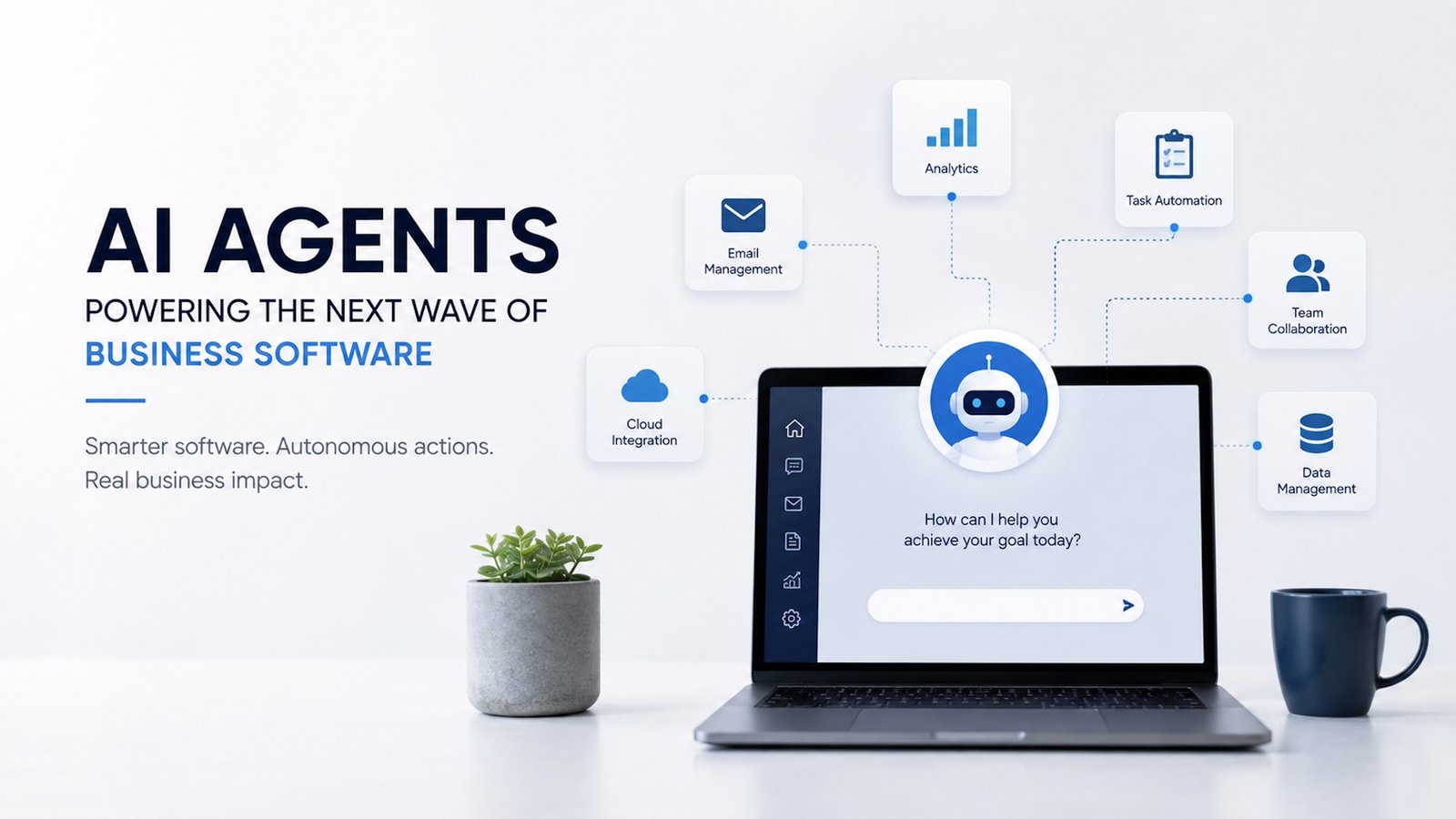
AI agents are starting to challenge that pattern. Rather than waiting for a person to initiate every action, an agent can receive a goal, examine available information, decide which steps are needed, use connected tools, and continue working until it reaches an outcome or needs human input.
That change may sound subtle, but it has bigger consequences for business software than adding another chatbot to an existing application. If agents become dependable enough for everyday work, businesses may gradually move from operating software themselves to supervising software that can perform parts of a process on their behalf.
What Makes an AI Agent Different From Regular Automation?
Traditional automation works best when the process is predictable. A business can create a rule saying that when a customer submits a form, the information should be entered into a CRM and a confirmation email should be sent. The workflow follows the same predefined path each time.
An AI agent can deal with tasks where the path is less fixed. It can interpret a request, examine context, choose among available actions, call external tools, review the result, and decide what should happen next. The agent is still operating within technical and business boundaries, but every step does not necessarily need to be manually scripted beforehand.
Consider a sales request. Conventional automation might route a new lead based on location or company size. An agent could read the inquiry, examine previous interactions, retrieve relevant account information, classify the request, prepare a response, recommend a salesperson, and create follow-up tasks. A person can then review sensitive decisions rather than handling every administrative step.
Business Software Is Moving From Tools to Task Execution
Most software applications are designed around features. CRM software has contact records, pipelines, reports, and activity screens. Project management platforms have boards, tasks, calendars, and notifications. Accounting systems have invoices, expenses, reports, and reconciliation tools.
Agents introduce another way to interact with those features. Instead of learning where each function is located, a user may increasingly describe the outcome they need. An agent can then determine which functions, data sources, and connected applications are required to complete the task.
A manager, for example, might ask an agent to identify delayed customer projects, determine which ones are waiting for internal approval, prepare a status brief, and notify the appropriate project owners. That request could normally involve several reports, filters, messages, and applications. An agent can potentially coordinate those steps behind a single request.
This does not mean graphical interfaces will disappear. People will still need dashboards, records, reports, and controls. The difference is that navigating those interfaces may no longer be the only way to get useful work done.
Agents Can Work Across Software Boundaries
One of the biggest frustrations in business technology is that work rarely stays inside one application. Customer information may live in a CRM, contracts in document storage, invoices in accounting software, conversations in email, and project details in another platform.
Employees become the bridge between those systems. They copy information, check multiple screens, send updates, create tasks, and make sure one application reflects what happened in another. APIs and workflow tools have reduced some of that manual work, but cross-application processes can still require considerable setup.
AI agents can provide another layer between these systems. When they have controlled access to APIs and business data, agents can retrieve information from one application, reason about what it means, and take an approved action somewhere else.
Building this type of system requires more than connecting an AI model to an API. Teams working on AI development services need to think about permissions, business rules, data access, model behavior, error handling, logging, and where human approval should remain mandatory.
The Biggest Change May Be in Everyday Work
AI agents are often discussed through ambitious examples of autonomous systems running entire workflows. Their more immediate value may come from much smaller tasks that employees repeat every day.
A support employee might use an agent to gather a customer’s history before responding to a ticket. A finance team could ask one to identify unusual invoice records and collect the supporting information for review. A project manager might use an agent to compile updates from several systems before a weekly meeting.
None of these examples requires removing people from the process. They reduce the amount of time people spend searching, transferring, organizing, and preparing information before they can make a decision.
That distinction matters because many business processes contain both mechanical and judgment-heavy work. Agents are better suited to taking on well-bounded repetitive steps while people retain responsibility for decisions involving risk, negotiation, policy, or unusual circumstances.
Software Could Become More Personalized to Each Role
Traditional business applications usually give groups of users roughly the same interface. Administrators configure roles and permissions, but employees still need to understand the application’s structure and determine how to use its features for their particular job.
An agent can potentially create a more contextual experience. A salesperson could interact with the same CRM differently from a sales manager. The salesperson might ask for accounts requiring follow-up, while the manager might ask why deals are slowing down in a particular stage.
The underlying software and data can remain the same while the agent changes how users reach them. This could make complex business systems easier to use, especially for occasional users who do not know every menu, report, or filter.
It could also change how businesses evaluate software. Feature count may matter less if an agent can combine existing capabilities into useful actions based on the user’s role and request.
See also: Lithographic Printing Technology and Precision Desktop CNC Router
Human Approval Still Has a Place
Giving an AI agent access to business applications also creates obvious risks. An incorrect answer in a chat window is inconvenient. An incorrect action inside a billing, customer, HR, or production system can have real consequences.
Businesses therefore need to distinguish between actions an agent can perform independently and actions that require approval. Reading records and preparing a summary carries a different level of risk from issuing a refund, deleting data, changing an employee record, or approving a payment.
A useful agent design can include permission levels. Low-risk tasks may run automatically, medium-risk actions may require confirmation, and high-risk decisions may remain entirely with a person. Logs should also show what the agent accessed, what action it attempted, and why the workflow reached a particular state.
These controls become especially important as agents gain access to more tools. Greater access can make an agent more useful, but it also increases the impact of a mistake or poorly interpreted instruction.
Data Quality Becomes Harder to Ignore
An agent can only make useful decisions from the information available to it. If customer records are incomplete, product information is outdated, or several systems contain conflicting versions of the same data, an agent can act on those weaknesses faster than a person would.
This makes data preparation an operational issue rather than simply an AI issue. Before allowing agents to perform meaningful business tasks, companies need to understand where authoritative information lives, who can access it, how frequently it changes, and which data should never be exposed to a model.
The same principle applies to context. An agent responding to a customer may need order history and support records, but it probably does not need access to unrelated employee information. Giving an agent every available data source is rarely a sensible shortcut.
Good agent systems are often defined as much by what they cannot access as by what they can.
Building an Agent Is Only Part of the Job
A prototype agent can be surprisingly quick to create. Turning that prototype into dependable business software is a different challenge.
Production systems need authentication, access controls, API management, monitoring, fallback behavior, testing, cost controls, and a way to handle situations the model cannot resolve. Teams also need to evaluate how the agent behaves when information is incomplete, a connected service is unavailable, or a user gives an ambiguous instruction.
The skills required can span AI engineering, backend development, data engineering, cloud infrastructure, security, and product design. Companies that do not have all of those capabilities internally sometimes hire AI/ML developers to extend an existing product team rather than treating the agent as a standalone experiment.
The goal should not be to give an agent as much autonomy as technically possible. The better question is how much autonomy a particular business process can safely support.
Not Every Workflow Needs an Agent
The attention around AI agents can make them appear suitable for almost every software problem. They are not.
If a task follows clear rules and produces predictable outcomes, conventional code or workflow automation may remain the better choice. It is easier to test, easier to audit, and often cheaper to run. Adding an AI agent to a deterministic process can introduce uncertainty without providing much benefit.
Agents become more interesting when a process involves interpreting unstructured information, choosing among several possible actions, working across multiple tools, or adjusting the next step based on what happened previously.
A practical approach is to start with the workflow rather than the technology. Map the task, identify where people currently spend time interpreting or coordinating information, and then determine whether an agent actually improves that part of the process.
What Businesses Should Test Before Giving Agents More Control
A useful pilot should measure more than whether an agent can complete a demonstration. Businesses need to know how it behaves across ordinary cases, incomplete information, unusual requests, system failures, and incorrect user instructions.
Accuracy is only one measure. Teams should also examine task completion rates, unnecessary tool calls, human correction rates, response time, operating cost, permission violations, and the percentage of cases that need escalation.
Starting with a narrow workflow makes those questions easier to answer. An agent that prepares account summaries for sales representatives is easier to evaluate than one that is immediately allowed to update records, contact customers, change prices, and create contracts.
Once the narrow use case becomes dependable, access and responsibility can expand gradually. This approach also gives employees time to understand where the agent helps and where human judgment remains necessary.
The Software User Is Becoming a Supervisor
The most interesting part of AI agents may not be the technology behind them. It may be the way they change the relationship between people and software.
Business applications have traditionally required people to translate their goals into clicks, searches, fields, filters, and predefined workflows. Agents offer the possibility of reversing some of that relationship. A person describes the goal, while the software works out which permitted actions can help reach it.
That shift will not happen everywhere at once, and fully autonomous business systems are unlikely to be the right answer for many processes. Rules, permissions, human review, and conventional software will continue to matter.
What is changing is the amount of operational work software can potentially take on. As agents become connected to real business tools and data, employees may spend less time operating applications step by step and more time setting goals, reviewing outcomes, handling exceptions, and deciding what should happen next.


 By
By