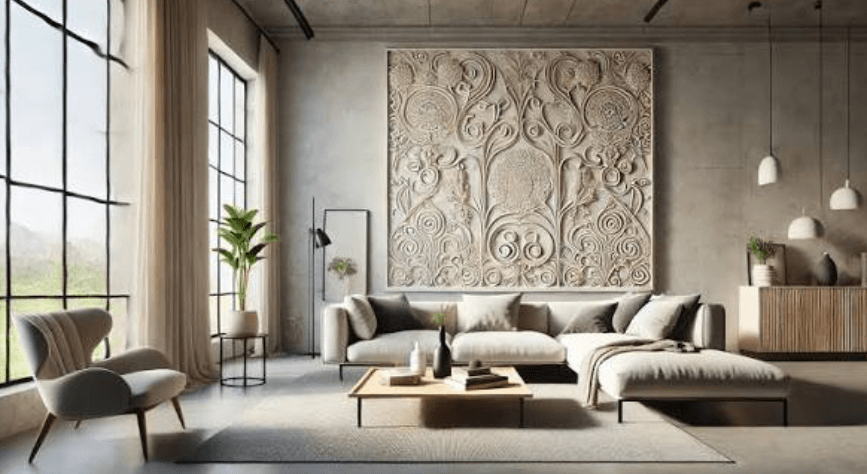

Flat art has a ceiling. No matter how good the color or composition is, a flat canvas only ever looks like what it is from every angle in the room. Walk past a textured piece, though, and it actually changes — shadows shift, ridges catch the light differently depending on where you’re standing. That’s not something a regular painting can do, and it’s exactly why textured plaster art has become such a go-to for anyone wanting their walls to feel a little more alive.
What Makes Textured Plaster Art Different
Most wall art is two-dimensional in every sense. Plaster art isn’t. It’s built up in layers, often with visible ridges, swirls, or raised sections that give it actual physical depth. You’re not just looking at a picture — you’re looking at a sculpted surface that happens to hang on a wall.
That physicality changes how the piece behaves in a room. Morning light hits it differently than evening light. A lamp positioned to one side creates shadows across the ridges that a flat print simply can’t produce. It’s art that responds to its environment instead of just sitting there looking the same all day.
Why It Works So Well as a Statement Piece
It Draws the Eye Without Needing Bright Color
A lot of statement pieces rely on bold color to grab attention. Plaster art can do the same job with texture alone, even in muted neutral tones. That makes it a good fit for people who want visual impact without committing to a loud color palette in their living room.
It Adds Depth to Minimal or Neutral Spaces
If you’ve leaned into a minimalist or neutral color scheme, your walls can start to feel a little flat after a while. Textured plaster breaks that up without clashing with the rest of your simple, clean decor. It’s subtle enough to fit the aesthetic but interesting enough to actually be noticed.
It Feels Handmade in a World of Mass-Produced Everything
There’s something about a raised, imperfect surface that just reads as more personal than a flat print. Even when it’s not a one-of-a-kind piece, the texture gives it a handcrafted quality that’s hard to fake with a regular canvas print.
If you’re looking to actually bring this into your space, browsing a collection of plaster art is a good way to see just how much variation exists within the style — from subtle, barely-there texture to seriously sculptural pieces that practically come off the wall.
Where Textured Plaster Art Works Best
Above a Sofa or Fireplace
These are the natural focal points of most living rooms, and a large textured piece here does a lot of heavy lifting on its own. You often don’t need to add much else around it.
In an Entryway With Good Lighting
If you have a light source near your entryway — a window, a sconce, anything that creates some directional light — a textured piece here can look genuinely different depending on the time of day. It’s a small detail, but people notice it.
As a Single Piece Instead of a Gallery Wall
Textured plaster art tends to work best as one significant piece rather than grouped with several smaller ones. The texture needs a bit of visual breathing room to actually stand out, and crowding it with other art can flatten the effect.
See also: Orlando Business Law Attorney: Legal Guidance for Growing Businesses in Central Florida
Pairing Plaster Art With Your Existing Decor
With Neutral, Natural Materials
Wood, linen, stone, unglazed ceramics — these all sit comfortably next to a textured plaster piece because they share a similar tactile, organic quality. Avoid pairing it with anything too glossy or high-shine, since the contrast can feel jarring rather than intentional.
With Warm Lighting
Because texture depends so much on shadow, warm ambient lighting tends to bring out more depth than harsh, flat overhead lighting. A simple floor lamp or wall sconce angled toward the piece can make a noticeable difference.
With Bolder Styles, Too
Don’t assume texture only works with quiet, neutral decor. It can pair surprisingly well with bolder aesthetics too. If your space leans toward warm, nostalgic, or rustic Americana-style decor, a collection like Americana wall art can actually complement a textured plaster piece nicely — the rougher, handcrafted feel of both styles tends to share the same grounded, authentic energy, even though the color palettes might differ.
Choosing the Right Piece for Your Wall
Size Matters More Than You’d Think
Textured pieces often look best a bit larger than you might initially plan for. Because the surface isn’t flat, a smaller piece can lose some of its visual impact from across the room. If you’re torn between two sizes, it’s usually worth going bigger.
Consider the Direction of the Texture
Some plaster pieces have texture that runs in one clear direction — horizontal ridges, circular swirls, diagonal lines. Think about how that direction interacts with the furniture below it. A piece with strong horizontal lines above a low, wide sofa tends to look more balanced than one with busy, chaotic texture in the same spot.
Don’t Ignore the Color Underneath
Texture gets a lot of attention, but color still matters. Muted, earthy tones tend to be the most popular choice for textured plaster pieces, since they let the shadow and light do most of the visual work instead of competing with a bold color.
Caring for Textured Plaster Art
These pieces are generally low-maintenance, but a few things help keep them looking good over time.
- Dust gently with a soft, dry brush rather than a cloth, since cloths can catch on raised ridges
- Avoid hanging in bathrooms or other high-humidity areas unless the piece is specifically sealed for moisture
- Keep it out of direct, constant sunlight to prevent the color from fading unevenly across the raised and recessed areas
FAQ
Is textured plaster art fragile?
Not typically. Once cured and sealed, most pieces are fairly durable for normal indoor use. They’re not meant to be touched constantly, but everyday household conditions won’t damage them.
Does textured plaster art work in small rooms?
Yes, as long as you’re mindful of scale. A single well-placed piece can actually make a small room feel more dynamic, since the texture adds depth without requiring extra floor space or furniture.
How is plaster art different from a regular textured canvas print?
A textured print usually simulates texture visually, sometimes with a slightly raised coating, but it’s still fundamentally flat. True plaster art is sculpted by hand, layer by layer, so the depth and shadow are real, not printed on.
A flat wall can only do so much for a room. Textured plaster art gives you something that actually shifts and changes throughout the day, which is a pretty rare quality for something that just hangs there and doesn’t move.


 By
By