
A paving crew cannot correct a weak foundation by relying on an accurate machine. The base must hold its level, resist movement, and carry the finished slab without uneven settlement. A road roller prepares that foundation by compacting granular material before the paving crew begins.
Road rollers cost money, but poor compaction can waste far more. Good preparation gives the paving train a reliable surface and allows its guidance system to hold the required line and grade.
Why does continuous paving improve consistency?
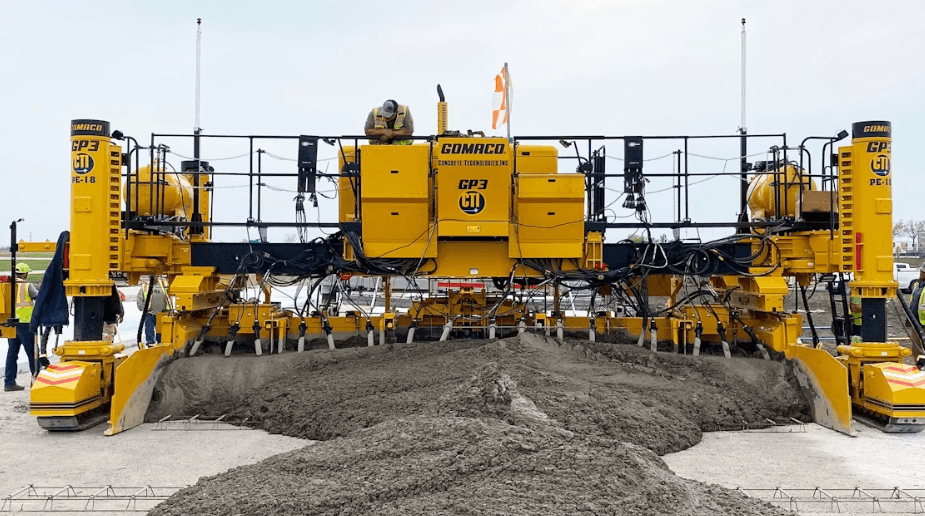
A slipform machine receives fresh concrete at the front, spreads it across the working width while the internal vibrators remove trapped air so that the mix settles around. As the machine advances, the mould shapes the slab while control systems maintain thickness, alignment and crossfall.
This continuous movement removes much of the interruption associated with fixed forms. Crews do not need to place, align and remove long sections of shuttering. Steady progress also reduces the number of construction joints, although the team must still plan deliberate joints carefully.
The machine cannot work well with an inconsistent mix. Concrete that arrives too wet may lose edge shape. A dry mix can resist consolidation and leave voids. The batching plant, haul vehicles and paving crew must keep delivery times and mix properties within a narrow range. When trucks arrive irregularly, every stop creates another place that needs close finishing.
Paving accuracy reduces correction work
Modern paving controls help the machine follow a planned line, level, and slope. Newer arrangements may use digital models or total stations. The method matters less than careful calibration. A badly set sensor can guide the machine consistently in the wrong direction.
Accurate control protects material quantities. If the machine lays a slab thicker than the design, concrete use rises over every metre. If it works too thin, the pavement may fail to meet specification. Survey checks should continue throughout the shift rather than only at the start.
Where does a flooring saw fit?
Concrete begins to shrink as it loses moisture, and that is when contractors control the resulting stress by cutting joints at planned intervals. A flooring saw creates those cuts after the slab gains enough strength to resist edge damage but before uncontrolled cracks appear.
Timing changes with weather, mix design, slab thickness, and curing conditions. Hot, dry weather may shorten the available cutting window. The crew should inspect the concrete rather than follow a fixed clock. Cutting too early can tear the joint edges; cutting too late allows random cracking to start.
The best flooring saw for a project matches the required depth, blade size, production rate and site access. A small machine may suit short kerb sections, while a larger self-propelled unit handles long pavement joints more efficiently. Blade selection also affects cut quality and working speed.
Productivity depends on the whole paving train
A paver may have ample capacity, yet the project will only move as quickly as its slowest supporting stage. The batching plant must supply enough concrete. Trucks need clear routes. The placing crew must distribute material evenly in front of the machine, and the finishing team must attend to edges, transitions, and start points.
Curing starts immediately after finishing. If the surface loses moisture quickly, it develops shrinkage cracks. Texture also needs close control because roads and runways require suitable grip. Experienced workers still manage details that the machine cannot judge.
See also: Orlando Business Law Attorney: Legal Guidance for Growing Businesses in Central Florida
Versatility brings practical limits
Slipform equipment requires space for delivery vehicles, guidance systems and a continuous operating path. It offers poor value on a short, irregular section filled with tight corners and service covers. Fixed forms and smaller placing equipment may suit such work better.
Mobilisation also takes planning. Crews must transport the machine, assemble attachments, fit the mould, set the controls and complete trial checks. After paving, they must clean concrete from the mould, vibrators and working parts before it hardens.
Buying decisions should reflect the contract pipeline. A contractor examining a slip form paver for sale should compare paving width, mould availability, control compatibility, transport dimensions and local parts support. Frequent, repetitive work may justify ownership. Occasional projects may favour hire or specialist subcontracting.
Conclusion
A slipform paver combines spreading, consolidation and shaping while it moves steadily along the prepared route. That ability explains its value on highways, runways, barriers, kerbs and drainage work. It can deliver accurate, repeated profiles, but only when the site supports continuous operation.
Successful paving still depends on preparation, concrete consistency, guidance checks, joint cutting and curing. The machine does not remove the need for skilled judgement. It gives an experienced crew a precise method for turning a well-prepared base and controlled concrete supply into a durable finished structure.


 By
By