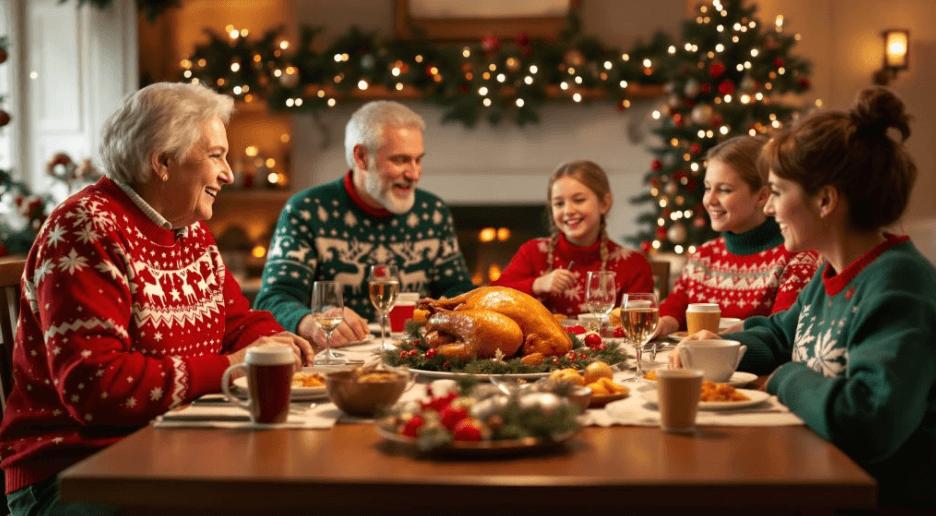

Holiday hosting advice is overwhelmingly concerned with food. Timelines for the bird, make-ahead sides, how many people a given table seats, what to do when the oven is full. All useful, and all addressed to a problem that ends the moment the plates are cleared. The stretch that follows, roughly three hours of a full house with nothing scheduled, receives almost no attention despite being longer than the meal and considerably harder to manage.
The Post-Dinner Drift
What happens by default is well documented by anyone who has hosted. A game plays on the television that perhaps four people are watching. A second group forms in the kitchen around the leftovers. Someone falls asleep in a chair. The teenagers are upstairs. Conversation happens, but it happens in the same small clusters that formed at the table, and the wider group that took considerable effort to assemble effectively dissolves.
Hosts notice this and often blame themselves for it. They should not. The drift is structural. A large group with no shared focus will always fragment into its constituent friendships, and no amount of hospitality prevents it. The only thing that reliably interrupts the pattern is giving the room one thing to point at.
Why Television Does Not Solve It
The default shared focus is the screen, and it works poorly for the purpose. Watching something together produces very little interaction, which is usually the point of watching something together and exactly the wrong property here. A film also commits the group to two hours, which is longer than the room’s collective patience and guarantees that a third of the audience leaves midway.
The more interesting development of the last few years is that the same screen has started to be used differently. Rather than broadcasting to the room, it hosts something the room participates in. The hardware requirement is nothing more than a smart television and a browser, which most households hosting a holiday meal already have.
Multigenerational Is the Actual Constraint
Any holiday activity has to survive a brutal test: it must work simultaneously for people separated by sixty or seventy years of cultural reference. This is where most party games fail. Contemporary trivia loses the older relatives. Nostalgia formats lose the children. Physical games lose anyone with a bad knee, which after a large meal is close to everybody.
The formats that hold up share a specific property. They are built around material that has been passed down within families rather than material tied to a single moment. Films are unusually good at this. A film watched repeatedly in a household over twenty years becomes common property across every generation living in it, which makes it one of the few reference pools a room spanning four decades can all draw on.
Teams Fix the Age Problem
Individual play magnifies the reference gap. Team play cancels it. Split a room into two or three teams with mixed ages and each team ends up holding a different slice of the catalogue, which forces exactly the conversation the holiday was supposed to produce. The grandchild knows the recent titles. The grandmother knows everything from the seventies. Neither wins alone.
Purpose-built seasonal formats have started to lean into this deliberately. Reel Culture packages a holiday family game night around Black movie trivia scaled for Thanksgiving, Christmas, Kwanzaa and MLK Day gatherings, with configurable round lengths and an optional clock so the same set works for a competitive group of adults and a room with children in it. The free starter pack runs without a signup, which matters more than it sounds when the alternative is asking guests to create accounts during dessert.
Practical Notes for Hosts
Three things separate a post-dinner activity that works from one that dies quietly. The first is starting before anyone has settled. There is a window of perhaps twenty minutes after the plates are cleared when the group is still standing and still together, and that window closes permanently.
The second is keeping rounds short. A ten or sixteen question round with a visible endpoint outperforms an open-ended game every time, because it lets people commit to something small and then ask for more. The third is running the timer off for the first round. Pressure is fun once people understand the format and alienating before they do, particularly for older relatives who will simply stop participating rather than complain about it.
See also: Whole Life vs. Term Life Insurance: Which Is Right for You in Hong Kong?
The Hours Nobody Budgets For
Hosts spend weeks on a meal that lasts fifty minutes and nothing at all on the three hours that follow it. The imbalance is understandable, since the food is the part that can visibly go wrong. But nobody remembers a holiday for the sides.
What people remember is which relatives they actually spoke to, and whether the room stayed together or quietly came apart at eight o’clock. That outcome is not luck. It is a decision the host makes, usually without realising there was one to make.


 By
By