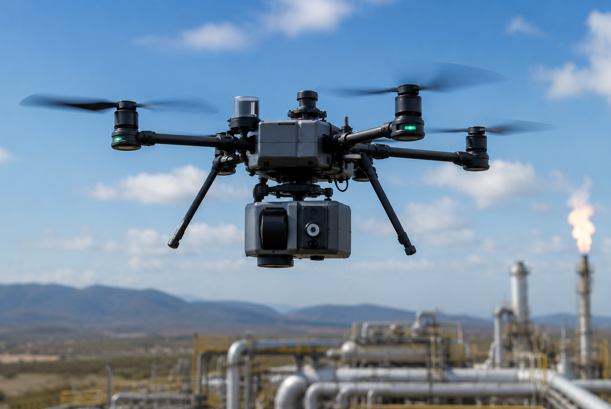

Unnamed Aerial Vehicles (UAVs) are transforming gas leak monitoring by replacing ground-based surveys with high-precision, speed, and labour-intensive intelligence. With advanced techniques, UAV methane detection now provides autonomous 3D mapping of several methane plumes and real-time quantification.
Key Takeaways
- With increased speed and efficiency, the UAV methane detection method provides real-time data and digital reporting.
- Since workers do not need to visit the hazardous sites, it protects them from explosions or any health issues due to toxic chemicals.
- Advanced sensors like OA-ICOS detect the concentration of methane at sites accurately.
Greenhouse gas monitoring via UAVs or drones is a safe and cost-effective method to identify the origin of the leakage and quantify emissions. Apart from landfill areas, onshore and offshore oil and gas production emit a significant amount of methane, which must be detected and measured before any accidents, as methane traps more than 28 times the heat, compared to carbon dioxide.
So, how does UAV methane detection benefit gas leak monitoring? How does it change the conventional idea of greenhouse gas detection? Let’s find out.
How is UAV Methane Detection Improving Gas Leak Monitoring in 2026?
Here are the top 5 ways UAV methane detection is revolutionising gas leak monitoring with advanced tools and techniques.
1. Drastically Increased Inspection Speed and Efficiency
In cases of large, remote, complex infrastructural screening for methane detection, the inspection speed and efficiency of UAVs are advantageous for accurate, real-time results. Especially in landfills or pipeline networks, it is used instead of traditional on-foot methods.
Here is how the speed of UAV methane detection helps in gas leak monitoring:
- UAVs complement a faster coverage process. While manual gas leak monitoring might take several days, UAVs can cover 60 hectares in a single day.
- The SPH Engineering official resellers opt for integrating autonomous drone missions into routine maintenance schedules, which allow for monthly or weekly inspections, instead of annual or quarterly checks.
See also: Cultivate Positivity and Mindfulness for a More Meaningful Daily Lifestyle
2. Enhanced Safety by Removing Personnel from Hazards
Workers often need to visit hard-to-reach or dangerous areas during methane detection, including hazardous landfill areas, high-pressure sites, and offshore platforms. The use of drones in landfill methane monitoring minimises risks, without compromising the results. Here’s how it benefits gas leak monitoring.
- Drones can be operated remotely, which allows operators to inspect hazardous infrastructure from a safe distance. It minimises the risks of toxic chemicals, fire, or explosion (methane is highly explosive if mixed with air by 5%-15%).
- In emergency scenarios, drones allow for a rapid assessment and review of a site’s condition before rescue or maintenance teams enter. It minimises the personnel risks on a significant scale
3. Superior Detection Sensitivity and Accuracy
The official resellers of SPH Engineering, equipped with advanced laser-based sensors (TDLAS), can identify isolated gas leaks as well. Here’s how it enhances the precision of methane detection:
- Drones pinpoint the particular source of a leak, such as a tank or a specific valve. It allows for rapid repairs with real-time data, driven by GPS-tagged facilities.
- Advanced sensors, such as OA-ICOS (Off-Axis Integrated Cavity Output Spectroscopy), detect methane concentrations with better sensitivity. These sensors also differentiate between industrial leaks and naturally occurring methane in wetlands.
- The integration of artificial intelligence (AI) with methane leak detection systems analyses patterns in sensor data, predicting potential leaks with 85% accuracy.
4. Real-Time Data and Digital Reporting
Drone-based methane detection provides real-time data that allows operators to take immediate steps, as per the gas concentrations. So, how does it work?
- On-screen integration allows for the detection of methane with a precise picture of the origin and size of the leak.
- The data collected regarding gas leaks is used in developing automatic and auditable reports. This is essential to meet regulatory standards, such as OGMP 2.0 (Oil and Gas Methane Partnership).
- The use of autonomous swarm technology, where operators can use multiple drones synchronously when covering larger and complex areas for gas leak detection, for 24/7 monitoring without human intervention.
5. Cost-Effective and Proactive Mitigation
Gas leak monitoring via drone is a cost-effective process, reducing the financial losses often associated with large-scale repair. Here’s how proactive mitigation helps in long-term security.
- Drone in landfill methane monitoring or in cases of oil and gas industry helps operators reduce the environmental footprint with real-time data about the source of the gas.
- With fixed-wing UAVs, operators can follow pre-programmed routes along pipelines, ensuring high-frequency, consistent monitoring without manual intervention.
Now, check the table below to know about key technologies used for UAV methane detection.
| Technologies | Significance |
| Optical Gas Imaging | Infrared cameras to detect methane plumes. |
| Remote Laser Methane Detection | Sharing a laser towards the ground or tank, and analysing light to examine methane concentration. |
| Autonomous Flight and Mapping | Following autonomous, pre-programmed paths, drones are used for routine inspection – no need for manual piloting for data collection. |
| Sniffer Sensors | Using metal-oxide or electrochemical sensors, these sensors directly measure gas concentrations (with closer proximity only). |
Table 1: Key Technologies for UAV Methane Detection
How Does UAV Methane Detection Differ from the Traditional Method?
Here are the key differences between traditional methane detection and UAV methane detection.
| Feature | UAV-Based Methane Detection | Traditional Detection Methods (Ground/Handheld) |
| Speed/Efficiency | High: Can cover large areas, such as landfills and pipelines. | Low: Labour-intensive. |
| Safety | High: Remote monitoring keeps workers away from hazardous areas. | Lower: Inspectors need to approach leaks and hazardous zones physically. |
| Accessibility | Excellent: Accesses unstable or elevated areas. | Poor: Difficult to survey remote or dangerous areas. |
| Detection Type | Aerial sniffing or Remote Open-Path Laser (OP-TDLAS) from a distance. | Point detection (handheld sniffer) or visual inspection (OGI camera). |
| Data/Mapping | Provides 3D plume mapping, automated reports, and georeferenced real-time data. | Localised data only; depends on manual documentation. |
Table 2: Differences between UAV and Traditional Methane Detection Methods
Get the Best UAV Methane Detection Service in Landfill Areas or Oil and Gas Industries
Looking for advanced drone technology and applications in gas leak monitoring? Opt for the best service in your area for cost-effective support. Check brand reviews and experience in gas leak monitoring with real-time detection and data to get the best outcome.

 By
By