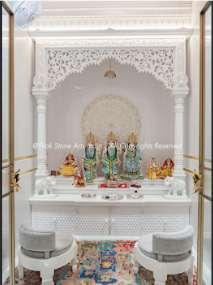

A hand-carved white marble temple is not built in a hurry. It begins with a single block of stone, and ends, sometimes a year later, with something that holds its place in a home for generations. The space between those two points is where most people never get to look. So let’s walk through it.
Where the Stone Comes From
The white marble temple starts long before the chisel touches it. The marble itself has to be right.
For temple work, the Vietnam White Marble is the stone of choice. You may also hear it called Swiss White Marble, Super Fine White Vietnam Marble, or simply Vietnam Marble. They all point to the same material. It has a soft, milky white tone with very fine grain, and it carries a quiet glow that other white marbles struggle to match.
There is a reason it has taken over the temple craft. Older white stones used decades ago often carried grey veins, dull patches, or hairline cracks that showed up months after carving. Vietnam White is different. It is dense, even in colour, and steady under the chisel. That steadiness matters more than people think. A vein in the wrong place can ruin a dome.
The stone arrives in big rough blocks, often weighing several tons. Workers inspect each block by hand. They reject some, perhaps one in three. The good ones move to the workshop floor.
The Design Comes Before the Cut
Before any carving begins, the temple exists only on paper. Or these days, partly on a screen.
A specialised mandir designer, someone trained for years on the language of temples, sits with the client. The questions are practical. How tall is the pooja room? Is the temple meant for daily aarti or larger pujas? How many idols will sit inside? Does the family want to follow a specific Vastu direction?
From there, the drawing begins. A traditional South Indian gopuram looks nothing like a North Indian shikhara, and a modern minimalist mandap is its own world again. Some clients want intricate jaali work. Others ask for clean, simple lines.
The sketch goes back and forth. The designer adjusts small details. The height of a pillar, the curve of an arch, the depth of the carving on a panel. Only after the client approves the design does the stone move.
See also: Cultivate Positivity and Mindfulness for a More Meaningful Daily Lifestyle
Cutting the Rough Shape
The first cuts are not delicate. They are heavy, loud, and they fill the workshop with white dust.
Large diamond saws bring the block down to a rough form. Carvers cut pillars from one piece of stone where possible, because joins always show later. They block out domes as solid masses, then slowly hollow them from inside. This stage moves fast, but it sets the tone for everything that follows. A poor rough cut means the carver has to fight the stone for weeks.
Some workshops still do parts of this stage by hand, using older tools. It is slower, and yet for very fine domes it gives more control.
The Hand Carving
This is where the white marble temple starts becoming a temple.
A senior karigar, often a man whose father and grandfather were also stone carvers, picks up his chisels. There may be twenty different sizes laid out beside him. The smallest is no thicker than a pencil. He works with a small hammer, tapping in a steady rhythm that you can hear from outside the workshop.
Hand carving covers the parts that machines cannot reach with any tool. The petals of a lotus base. The folds in a deity’s robe. The fine lattice of a jaali screen. The bells along the edge of a chhatri.
A single panel may take a week. A full pillar, three weeks. A large dome with deep relief work, two months or longer. The carver moves slowly because marble does not forgive. One wrong strike, and a piece that took ten days is gone.
You can usually tell hand-carving from machine work if you look closely. Hand work has tiny variations and a softness in the curves. Machine work is cleaner but flatter. Most premium temples use both machines for the bulk and human hands for the detail.
Reaching Your Home
A temple built once in a workshop in India might be installed again in a home in California, Toronto, Sydney, or Dubai. The reassembly on site is a careful job. A trained team unpacks each piece, places it, levels it, and seals the joints with a stone-safe adhesive. A medium temple takes a day or two to install. A large one, almost a week.
When it is finally standing, lit from above, with the first lamp placed inside, you understand why the work took so long. The stone holds the light differently. The carvings catch shadows. The space around it changes.
That is what a hand-carved white marble temple is, in the end. Stone shaped slowly, by patient hands, and set down quietly in your home.


 By
By