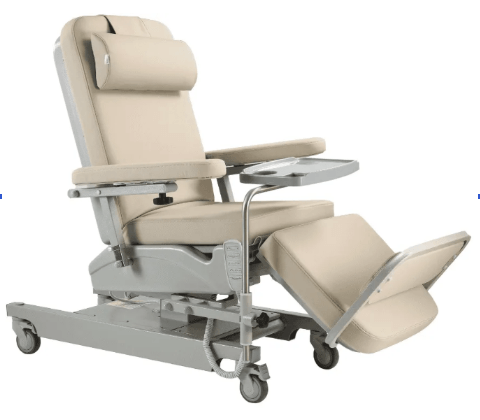
Renal care in India has changed considerably over the past decade. Dialysis centres face growing pressure to deliver longer sessions with fewer complaints, faster patient turnaround, and tighter infection control between each use. Equipment that once sat quietly in the background is now central to how a centre performs and how it is perceived by both patients and regulators.
Across leading renal and nephrology units, dialysis chairs have moved well beyond their function as simple recliners. They now serve as treatment platforms that must support sessions of four to five hours, accommodate intravenous access throughout, enable position changes mid-session, and meet strict infection control standards. A chair that falls short on even one of these demands does not just inconvenience the patient. It creates real operational friction for the centre.
When Body Position Becomes a Clinical Variable
Electronic Adjustment as Clinical Necessity: Patients undergoing haemodialysis spend hours in a fixed position. That is not comfortable by default, and it is not safe by default either. Motorised backrest and leg rest adjustments allow clinical staff to reposition patients without physical effort, reducing the risk of pressure injuries and helping manage blood pressure fluctuations that are common during longer dialysis sessions.
Trendelenburg Positioning and Emergency Response: A routine quality check in any dialysis chair specification should confirm whether the unit supports Trendelenburg positioning. This tilt function lowers the head while raising the legs, and it is used when a patient experiences a hypotensive episode mid-session. Without it, clinical staff must improvise a response to something that is, in reality, a standard safety requirement in haemodialysis environments.
Programmable Memory Functions and Clinician Efficiency: In centres where several clinicians share the same chair across a shift, programmable memory positions reduce the time spent re-adjusting settings between patients. A handset that recalls a preferred recline and leg rest angle removes one small but repetitive task from an already demanding workload. Over the course of a busy week, those saved minutes accumulate into something worth noticing.
The Workflow Cost That Centres Rarely Calculate
Caregiver Ergonomics Matter More Than They Appear: Clinics tend to evaluate chairs from the patient’s side of the experience. Rarely do procurement managers consider what repeated manual adjustments, low seating heights, or limited reach around the chair cost nursing staff over a full shift. The chair a centre chooses shapes the physical demands and work pace of every caregiver on the floor.
Height Adjustment and IV Line Management: Electronic height adjustment looks minor on a specification sheet but transforms daily operations in practice. When a chair can be raised to a working height, inserting and monitoring IV lines becomes less physically demanding for the nurse attending to each patient. Over a full session block, that difference in posture and reach adds up in measurable ways.
Armrest Positioning and Session Stability: The armrest on a dialysis chair is not purely a comfort feature. It needs to hold a patient’s arm at the correct angle for IV insertion and monitoring throughout the session. Armrests that shift under weight, or that cannot be adjusted to suit different body types, create complications that take clinical time to resolve and can affect the integrity of the access site.
Hygiene Specifications That Cannot Be Treated as Optional
Surface Materials and Infection Control: The wellness of patients in a dialysis setting depends partly on how thoroughly equipment can be cleaned between sessions. Upholstery that resists disinfectant chemicals, does not absorb moisture, and shows no surface degradation after repeated wipe-downs is not a luxury specification. It is a basic clinical requirement in any centre that takes infection prevention seriously.
See also: Your Ultimate Guide to Fitness Trends and Healthy Living Hacks Revealed
What a Compliant Dialysis Chair Hygiene Specification Includes:
- Disinfectant-resistant upholstery rated to withstand repeated chemical cleaning without surface breakdown.
- Sealed seam construction that prevents fluid ingress at stitch lines and panel joins.
- Fire-resistant and abrasion-resistant fabric grades appropriate for clinical environments.
- Non-porous armrest surfaces that wipe clean without trapping residue between sessions.
- Powder-coated steel frames that resist corrosion from disinfectant sprays over extended use periods.
Frame Construction and Replacement Cycle Economics: Chairs that deteriorate under the chemical load of a busy dialysis unit create a replacement cycle that is costly and disruptive. Precision-welded steel frames with powder-coated finishes hold up considerably better than painted or plated alternatives. A chair that functions the same after three years of heavy use is a better long-term investment than a cheaper unit requiring replacement within eighteen months.
Safety Features That Define a Responsible Specification
Quick-Release Backrest and CPR Readiness: Some chair features exist not for daily comfort but for the moments when something goes wrong. A quick-release backrest that drops flat instantly gives clinical staff immediate access to a patient requiring cardiopulmonary resuscitation. In a haemodialysis setting, where patients carry complex comorbidities, that capability is not optional. Esthetica’s dialysis chairs are built with precisely this function in mind.
Low Access Height and Patient Independence: Patients attending dialysis are often elderly or managing mobility challenges from related conditions. A chair with a sufficiently low minimum access height reduces the effort required to transfer in and out of the seat. Centres that account for this tend to see fewer handling incidents, faster patient settling, and a measurably smoother start to each session.
Stability Under Load and Clinical Confidence: A chair that shifts or wobbles under patient weight introduces a persistent, low-level uncertainty into every session. Clinical staff become hesitant to assist with transfers, and patients lose confidence in the centre’s standards. A precision-welded frame with a tested weight capacity eliminates that uncertainty and creates a calmer, more controlled environment for both staff and patients.
Where Treatment Standards and Chair Specifications Finally Meet
The chair at the centre of a dialysis session carries more clinical responsibility than most procurement decisions acknowledge. Evaluating it against positioning, hygiene, safety, caregiver workflow, and long-term durability consistently leads to better outcomes than price-led comparisons alone. If your centre is planning a chair purchase or upgrade, consult a specialist manufacturer who can demonstrate clinical compliance across all of these dimensions, not just the obvious ones.


 By
By